

What companies can do now to keep their employees healthy and motivated.
Do you actually know how much the healthcare reform will cost your employees and your company? We’ve done the math: it’s going to get noticeably more expensive. The additional cost per employee can quickly add up to several hundred euros.
What if you could more than offset your employees’ reduced benefits and increased workload with a workplace wellness program?
The actual costs of healthcare reform
The upcoming healthcare reform is a comprehensive package of cost-cutting and regulatory measures for the public health insurance system. The goal is to prevent a growing funding shortfall by 2030 and, above all, to keep premiums stable. However, it will become more expensive for insured individuals and employers: higher copayments, higher premiums, and fewer benefits. Even though the bill has not yet cleared all hurdles in the Bundestag and Bundesrat, the following changes to benefits must be expected:
Financial burdens
1. Contribution ceilings and contributions
- The contribution assessment ceiling will be raised by approximately 300 euros in a one-time increase in 2027. This increase will directly affect employers, as they are responsible for paying the employer’s share of health insurance premiums.
- As the number of higher-earning employees increases, this leads to progressively higher contribution obligations.
- In the future, employers will be required to pay higher contributions for part-time workers. This measure is intended to ensure that part-time workers contribute more to health insurance, which will increase costs for employers.
2. Copayments and benefit reductions
- Dental Prosthetics: Health Insurance Coverage Decreases by 10 Percent
- Co-payments for medications are rising to as much as 15 euros
- Physical therapy: A flat copayment of 15 EUR per prescription
- Homeopathy will no longer be covered by health insurance
- Free skin cancer screening for people aged 35 and older is under review
3. Other changes to insurance benefits
- Family Insurance: Free coverage for spouses and domestic partners will be restricted and will only be available in exceptional cases
- Sick Leave and Recovery: The 6-week limit will apply per year rather than per illness
- Partial sick leave is available to allow employees to work on an hourly basis even while sick.
Even though the healthcare reform has not yet been finalized, insured individuals and employers will end up paying significantly more overall to close the funding gap.
At the same time, the relief bonus comes at an inopportune moment, because in addition to geopolitical and competitive strategy issues, HR managers are facing fundamental challenges that are inextricably linked to employee health and healthcare reform:
- 58.7% of employees report an increased workload over the past 12 months. Main factors: skills shortage (36.3%), economic uncertainty (27.9%), bureaucracy (26.3%), AI development (19.1%), restructuring (17.3%), generational change (11.8%).
- HR managers are also seeing an increase in sick leave (49.5%). Even now, the average number of sick days per employee stands at 22—and the trend is upward.
- These developments inevitably lead to declining engagement (41.7%), longer recruitment times (29.5%), and workforce adjustments (25.5%). Source: Factorial, HR Study 2026.
What if you could offset the benefit cuts resulting from healthcare reform, reduce sick days, and boost employee morale in the long term? Think it’s impossible? Think again!
How company-sponsored supplemental health insurance (bKV) can now become a win-win situation for both companies and employees!
To understand what a customized supplemental health insurance plan for employees can actually deliver in practice, we first need to dispel the common misconceptions that HR decision-makers in many places still have about such plans. And what could be more convincing than a before-and-after comparison?
For 26 years, we have been providing corporate benefits and insurance solutions for businesses. While corporate pension plans (bAV) are widely understood, there are still many misconceptions about supplemental corporate health insurance (bKV), as shown in Figure 1 below.
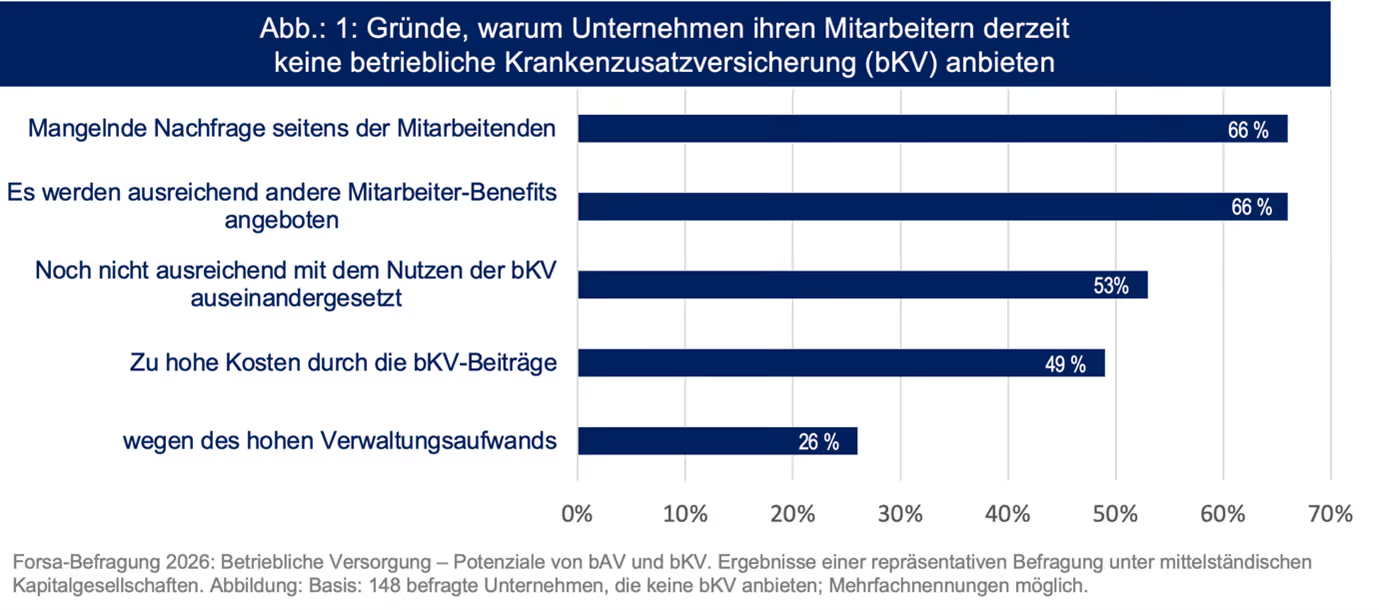
Anyone who deals with the cost-effectiveness of workplace health initiatives on a daily basis hears these prejudices quite often. What’s interesting, however, is that the arguments against supplementary health insurance are often made by decision-makers who do not offer such plans and are therefore unaware of the many benefits they provide!
However , when we look at companies that offer supplementary health insurance to their employees, nearly all of these preconceptions are completely disproved, as Figure 2 below shows.
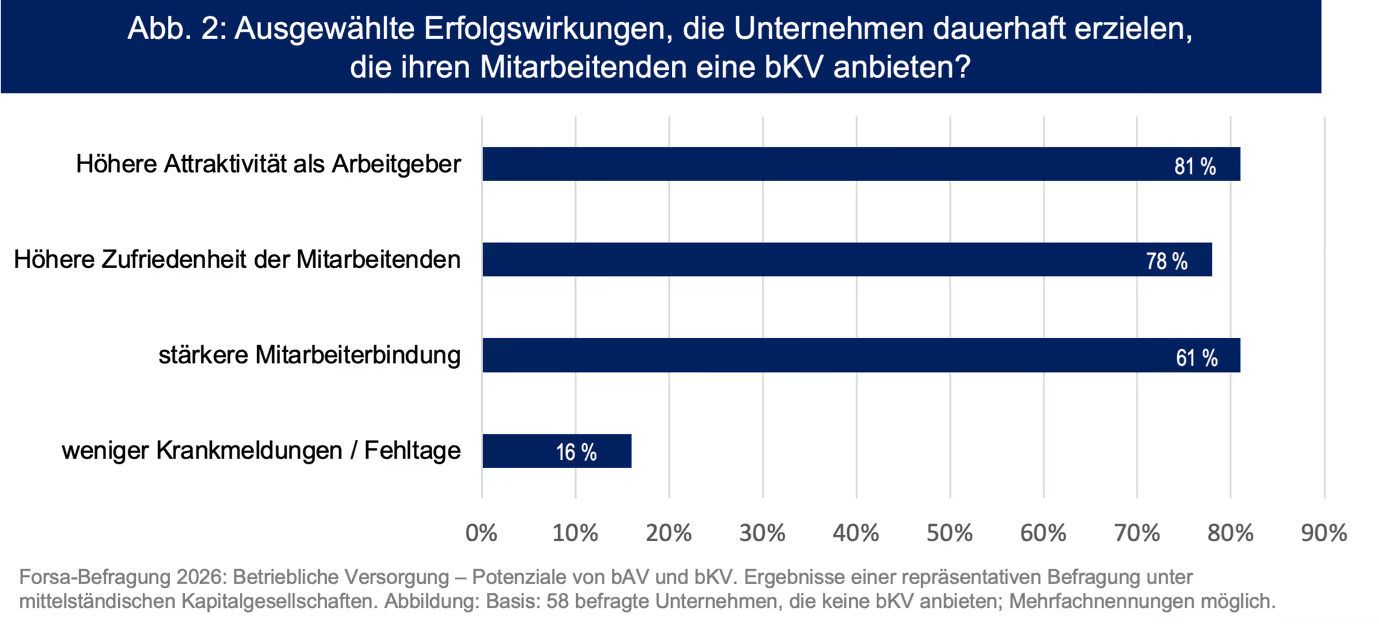
“Anyone who manages their company and staff responsibly must ask themselves: What does it cost my company not to have a supplementary health insurance plan?” (Tim Bütecke, owner and CEO of the HFH Group, Hamburg).
Back to the key question: How can supplemental health insurance (bKV) become a win-win situation for both companies and employees in the context of healthcare reform?
To illustrate this, we have compared selected changes to benefits resulting from the healthcare reform with the benefits of a supplementary health insurance plan. The results speak for themselves: With a customized supplementary health insurance plan, the cuts to benefits under the statutory health insurance system can be largely offset.
Based on our experience with supplementary health insurance, we know how an investment in workplace health management can be cost-effective and, above all, have a lasting impact. And that impact goes far beyond simply offsetting the benefit cuts listed in the example above. The following rough calculation is intended to illustrate this:
Why supplementary health insurance is always worth it!
For many companies, sick leave and absenteeism are just a number in HR reports. But this is dangerous, because they have significant economic consequences: lost productivity, increased workload for other employees, overtime, and sometimes even lost business.
Our experience shows that the total costs associated with lost workdays are rarely made transparent or honestly assessed. However, this is necessary to understand that reducing sick days by just a few percentage points is enough to fully offset the cost of a company-sponsored supplemental health insurance plan! The following example illustrates this point:
Supplementary health insurance costing 50 euros* per employee per month amounts to 60,000 euros per year for a company with 100 employees. That may sound like a significant investment—but it isn’t when you do the math:
- On average, an employee is absent from work for 20 working days due to illness. For a company with 100 employees, this would result in up to 2,000 (!) days of absence.
- A single sick day for an employee in the mid-wage bracket costs between 300 and 600 euros, depending on the industry and the method of calculation. (Source: Federal Institute for Occupational Safety and Health). For a company with 100 employees, this would mean lost revenue of between 600,000 and 1.2 million euros.
- A reduction in sick days of just three days per employee ( or 300 sick days for 100 employees) translates to savings of between 90,000 and 180,000 euros per year.
- And this calculation doesn't even take into account turnover and recruitment costs, or the costs—which are difficult to quantify—resulting from declining employee motivation (see above).
*Supplementary health insurance is considered a non-cash benefit. This means that up to 50 EUR per month per employee is exempt from income tax and social security contributions (Section 8(2), sentence 11 of the Income Tax Act).
Take advantage of the healthcare reform now to boost your health and motivation!
This simplified example makes it abundantly clear: Supplementary health insurance is not a social benefit or just another cost factor. It is an essential investment in the long-term health and well-being of all employees. And as such, it is a key driver of the company’s future success!
Nearly 70 percent of all employees would like their employer to offer personalized health benefits. This is a key reason for the significant growth of the supplemental health insurance market. Use the healthcare reform as a way to boost your employees’ health and motivation, and proactively explore the potential benefits of supplemental health insurance for your company. We would be happy to assist you in this process.
*As a full-service provider specializing in workplace health management and corporate health insurance, FAKTOR MENSCH supports clients from the initial consultation through to successful implementation and ongoing support. For 26 years now—based in Hamburg, serving all of Germany. Please feel free to contact us.
Ready to make a real difference?
We look forward to getting to know you and your company in person. Once you fill out the form, we'll get back to you right away.