Ich weiß gar nicht, was FAKTOR MENSCH eigentlich macht.
Ein Satz, den wir zuletzt häufiger gehört haben. Höchste Zeit, das zu ändern. Wir sind FAKTOR MENSCH – und wir stehen für eine neue Art, Gesundheit im Unternehmen zu denken.
HR am Wendepunkt: Live-Webinare am 16.10., 19.11. und 1.12.2026. Jetzt anmelden
Blog

Geschrieben von Günter Moeller
Markenexperte
Die Entlastungsprämie ist eine Reaktion der Bundesregierung auf die gestiegenen Energiepreise infolge des Iran-Kriegs, welche besonders Spritpreise und Lebenshaltungskosten in die Höhe getrieben haben. Die Maßnahme ermöglicht es Arbeitgebern, ihren Beschäftigten bis zu 1.000 Euro bis zum 30. Juni 2027 steuerfrei auszuzahlen, um finanzielle Belastungen abzufedern.
Die Entlastungsprämie ist eine freiwillige Leistung, die Arbeitgeber ihren Beschäftigten gewähren können, nicht jedoch müssen. Die Auszahlung erfolgt durch die Unternehmen selbst, wobei der Staat lediglich auf Steuern und Sozialabgaben verzichtet.
Während diese Maßnahmen als Entlastungen dargestellt werden, trägt somit faktisch der Arbeitgeber die Kosten. Kritiker argumentieren, dass die Bundesregierung damit staatliche Verantwortung auf Unternehmen verlagert, insbesondere auf kleine und mittlere Betriebe mit begrenzter Liquidität. Die Bundesregierung schafft eine steuerliche Ermächtigung – keine Subvention, keine Förderung. Die Kosten verbleiben vollständig beim Arbeitgeber.
Zudem muss die Entlastungsprämie von den Unternehmen zunächst erst einmal erwirtschaftet werden, bevor sie ausgegeben werden kann.
Beispiel: Ein Betrieb mit 100 Beschäftigten müsste beispielsweise 100.000 Euro Liquidität für die volle Prämie aufbringen. Dieses Geld fehlt dann für wichtige Investitionen.
"Sonderzahlungen entziehen Betrieben, die ohnehin unter Druck stehen, Liquidität für notwendige Investitionen. Das ist das Gegenteil einer mittelstandsfreundlichen Wirtschaftspolitik." Zentralverband des Deutschen Handwerks, April 2026
Wie umgehen mit der Entlastungsprämie? Welche Alternative bietet sich für die Einmalzahlung an?
Fakt ist: Die Bundesregierung hat mit dieser Maßnahme eine enorme Erwartungshaltung bei den Beschäftigten geweckt, die einer Zwickmühle gleichkommt. Was passiert, wenn die Prämie von Unternehmen A gezahlt wird – von Unternehmen B aber nicht? Welche Auswirkungen hat dies auf die Mitarbeitermotivation?
Hierzu Svea Bielert, Personalexpertin bei FRIEDERBARTH GmbH, Hamburg:
„Leistungsträger beobachten das ganz genau. In Mitarbeitergesprächen kommt nicht die Prämie direkt, sondern das Signal zur Sprache, nicht wertgeschätzt zu werden. Das ist das eigentliche Risiko für jedes Unternehmen."
Zugleich kommt die Entlastungsprämie zur Unzeit, denn neben geopolitischen und wettbewerbsstrategischen Themen, stehen Personalverantwortliche vor grundsätzlichen Herausforderungen:
Vor dem aufgezeigten Hintergrund muss die entscheidende Frage lauten: Was wäre, wenn wir die Entlastungprämie von 1.000 EUR pro Mitarbeitenden in einen „Gesundheits- und Motivationsbooster“ umwandeln? Die Erfolge, die Vorreiter-Unternehmen mit dem betrieblichen Gesundheitsmanagement und der hiermit einhergehenden betrieblichen Krankenzusatzversicherung (bKV) erzielen, sind belegt und durchweg positiv, wie der nachfolgende Standpunkt von Tim Bütecke, Inhaber und Geschäftsführer der HFH Group in Hamburg, verdeutlicht:
„Als Unternehmer mit über 25 Jahren Erfahrung kenne ich Krisen aus allen Perspektiven. Was ich dabei gelernt habe: Wer in der Krise aufhört zu investieren, verliert den Anschluss. Wer blind Geld ausgibt, verliert die Substanz. Es kommt darauf an, zum richtigen Zeitpunkt in das Richtige zu investieren. Die Entlastungsprämie ist gut gemeint — aber sie ist kein strategisches Instrument. Sie ist eine Einmalzahlung ohne nachhaltigen Effekt. Ich spreche hier auch als Betroffener: Als Arbeitgeber stehe ich selbst vor denselben Abwägungen wie unsere Kunden. Und ich habe mich für die bKV entschieden.“
Zu dieser klaren Empfehlung für ein betriebliches Gesundheitskonzept kommt auch Kai Kutter, Geschäftsführer von Battery-Kutter:
„Seit der Einführung der bKV mit FAKTOR MENSCH konnten wir den Krankenstand bei Battery-Kutter in nur 2 Jahren um 50 % reduzieren. Diese beeindruckende Entwicklung hat nicht nur die Zufriedenheit unserer Mitarbeitenden gesteigert, sondern auch die Effizienz und das Betriebsklima nachhaltig verbessert.“
Wir haben die Entlastungsprämie in Höhe von 1.000 EUR pro Beschäftigten als Ausgangspunkt für unsere Musterrechnung genommen (siehe nachfolgende Abbildung). Auf den Punkt gebracht bedeutet dies: Wenn Sie 40 EUR pro Monat/Mitarbeitenden und einer Laufzeit von 24 Monaten in eine bKV investieren, erzeugen Sie einen Gesundheitswert von 3.400 EUR und erzeugen damit den 3-fachen Wert für Ihre Mitarbeitenden. Ohne Liquiditätsschock, ohne Gesundheitscheck, steuer- und sozialversicherungsfrei.
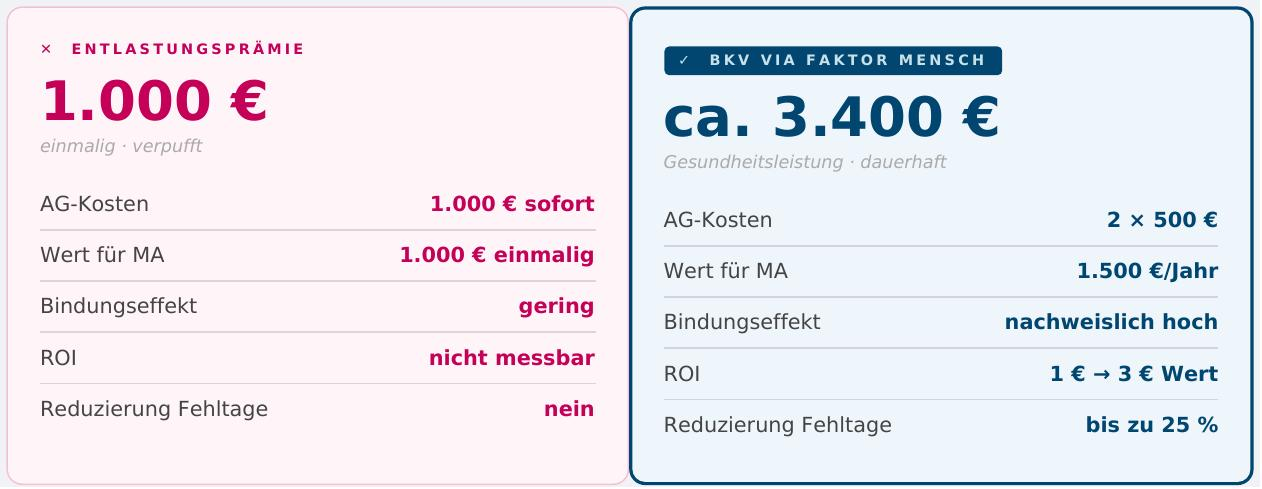
Eine bKV für 40 Euro pro Mitarbeitenden und Monat würde einem Unternehmen mit 100 Mitarbeitenden 40.000 Euro pro Jahr kosten. Klingt nach einer hohen Ausgabe. Ist es aber nicht, wenn man gegenrechnet: Ein vermiedener Krankheitstag eines Mitarbeitenden im Mittellohnbereich kostet einem Unternehmen je nach Branche zwischen 300 und 600 Euro. Bei einem Unternehmen mit 100 Mitarbeitenden und einem Rückgang des Krankenstands um nur drei Tage pro Person bedeutet das eine vermiedene Ausfallsumme von 90.000 bis 180.000 Euro im Jahr.
Die Kosten-Nutzenrechnung ist eindeutig: Die bKV ist keine Sozialleistung. Sie ist unternehmerisches Kalkül.
Die Frage muss spätestens an dieser Stelle lauten: Was kostet es Ihrem Unternehmen, nicht in die Gesundheit Ihrer Mitarbeitenden zu investieren
Der bKV-Markt wächst rasant. Unternehmen, die heute eine bKV einführen, positionieren sich als Vorreiter. Unternehmen, die warten, bis es Standard ist, verlieren den Differenzierungsvorteil. Schon heute bieten mehr als 86.000 Betriebe in Deutschland ihren Mitarbeitenden eine bKV an – das ist mehr als doppelt so viele wie 2022. Gleichzeitig haben noch neun von zehn deutschen Unternehmen keine bKV. Das Fenster der frühen Movers ist noch offen!
*Als Full-Service Dienstleister rund um das betriebliche Gesundheitsmanagement und die bKV begleitet FAKTOR MENSCH seine Kunden vom ersten Gespräch bis zur erfolgreichen Umsetzung und Begleitung. bKV-Beratung seit 2017, seit 2020 als FAKTOR MENSCH – aus Hamburg, für Deutschland. Sprechen Sie uns gerne an.
Geschrieben von
Markenexperte
Beratung sichern
Kostenlos, unverbindlich und versichererneutral: In 30 Minuten zeigen wir Ihnen, wie die bKV in Ihrem Unternehmen funktioniert.
Ein Satz, den wir zuletzt häufiger gehört haben. Höchste Zeit, das zu ändern. Wir sind FAKTOR MENSCH – und wir stehen für eine neue Art, Gesundheit im Unternehmen zu denken.
Viele Benefits klingen gut – auf dem Papier. Doch in der Praxis bleibt ihre Wirkung oft aus. Anders die betriebliche Krankenversicherung – vorausgesetzt, sie wird strategisch eingesetzt.
bKV-Tarife liegen typischerweise zwischen 10 und 50 Euro monatlich pro Mitarbeitendem. Tarife unter 50 Euro bleiben steuerfrei (Sachbezugsgrenze), höhere Tarife können pauschal mit 30 Prozent versteuert werden. Premium-Tarife mit erweiterten Bausteinen kosten 60 bis 100 Euro pro Monat.
Das Wichtigste in Kürze Bis 50 Euro im Monat bleibt der bKV-Beitrag steuer- und sozialversicherungsfrei, wenn er zusätzlich zum ohnehin geschuldeten Arbeitslohn gezahlt wird (§ 8 Abs. 2 Satz 11 EStG). Die Freigrenze gilt für alle Sachbezüge eines Monats zusammen. Wird sie überschritten, ist der gesamte Betrag steuer- und beitragspflichtig — nicht nur der übersteigende Teil. Oberhalb der Grenze kommen die Pauschalierung nach § 37b EStG mit 30 Prozent, die Pauschalierung nach § 40 EStG mit genehmigtem Durchschnittssteuersatz oder die individuelle Besteuerung in Betracht. Der Rechner stellt die Arbeitgeberkosten der bKV denen einer Gehaltserhöhung gegenüber, die beim Mitarbeitenden denselben Netto-Wert liefert. Wählen Sie ein Budget oder einen konkreten Tarif aus unserem Portfolio und vergleichen Sie direkt mit einer Gehaltserhöhung bei gleichem Arbeitgeberaufwand.
Beratung sichern
Wir freuen uns darauf, Sie und Ihr Unternehmen persönlich kennenzulernen. Wenn Sie das Formular ausfüllen, melden wir uns umgehend bei Ihnen.
Wählen Sie einen Termin
Tag wählenSchritt 1 von 5
Dauer
| Mo | Di | Mi | Do | Fr | Sa | So |
|---|
Hervorgehobene Tage haben freie Termine.
Uhrzeit (deutsche Zeit)
Bitte wählen Sie zuerst einen Tag.
Vielen Dank für Ihre Anfrage. Wir melden uns in Kürze.