


The world of work is facing one of the biggest regulatory upheavals in recent decades. With the gradual implementation of the new EU Pay Transparency Directive, companies across Europe will have to lay their cards on the table. What used to be a closely guarded secret—who earns how much and why?—will now be visible to employees and job applicants.
To many HR departments and CEOs, this initially sounds like a bureaucratic nightmare and increased pressure to justify decisions. However, those who approach the new transparency requirement with strategic foresight can turn it into a genuine competitive advantage. The key lies in a modern total compensation strategy—and a benefit that is currently experiencing an unprecedented boom: supplemental health insurance (bKV).
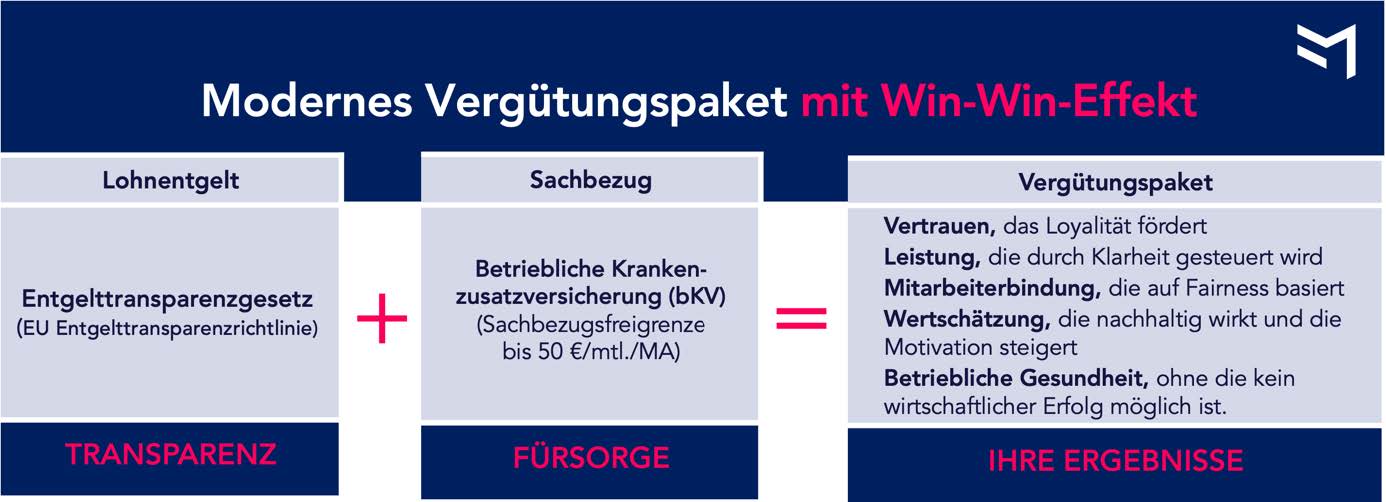
In this article, learn why supplemental health insurance (bKV) is the perfect complement to the new Wage Transparency Act and how you can successfully combine the two.
The New Law: More Than Just Numbers
The EU Pay Transparency Directive has a clear objective: to close the gender pay gap and enforce the principle of “equal pay for equal work or work of equal value.” For employers, this means, in concrete terms:
- Disclosure requirement: Salary ranges must be specified in job postings or before the first interview.
- Right to information: Employees are entitled to know the criteria for determining pay as well as the average salary of colleagues who perform the same work.
- Reversal of the burden of proof: In the event of a dispute, the company must prove that the compensation is fair and non-discriminatory.
It is important to note that the law does not define “compensation” solely as the traditional gross base salary. It includes all variable, supplementary, and additional benefits provided by an employer. And this is precisely where the strategic opportunity lies.
Supplementary Health Insurance as a Strategic Tool in the Age of Transparency
When salary structures become transparent, rigid compensation systems begin to falter. In this new environment, the bKV offers companies three key advantages:
1. Absolute fairness – Guaranteed to be free of discrimination
The Pay Transparency Act requires objective, gender-neutral criteria. A collective health insurance plan meets this requirement perfectly. If it is established as a collective plan for the entire workforce or for clearly defined groups (e.g., “all field staff”), there is no “subjective factor.” Everyone receives exactly the same first-class health benefits—regardless of age, gender, or negotiating skills. This directly contributes to the principle of fairness required by law.
2. The “Inclusion Miracle”: Maximum Value Without Barriers
A key problem with individual pay raises is often that they are eaten up by taxes and social security contributions. In addition, private supplemental health insurance on the open market is out of reach for many people due to pre-existing conditions or high premiums.
With supplementary health insurance (bKV), employees are completely exempt from a medical examination. Pre-existing conditions are also covered. For people with chronic conditions or older employees, this comprehensive health coverage is often more valuable than a few extra euros in gross salary. They receive an invaluable upgrade to the level of private health insurance.
3. Relief from the salary dilemma (net pay optimization)
This new transparency will lower the barrier for employees to ask for a raise. However, increases in gross pay alone can disrupt the internal structure and drive up non-wage labor costs. The bKV serves as a smart buffer here: Contributions of up to 50 euros per month can often be covered by the employer tax- and social security-free within the non-cash benefit exemption limit. For the company, the costs are predictable, while employees experience a tangible, highly emotional benefit in their daily lives (through an annual health budget for items such as eyeglasses, dental cleanings, osteopathy, or mental health prevention).
The Communication Strategy: How to Use the Duo to Build Your Employer Brand
Compliance with the law is a must—promoting it effectively is the icing on the cake. Leverage the combination of transparency and supplementary health insurance for your internal and external communications:
Internally: Appreciation instead of frustration with bureaucracy
Don’t present the implementation of pay transparency as a burdensome obligation. Link the introduction of transparent pay ranges directly to the presentation of your bKV health budget. The message is: “We’re making our salaries fair and transparent—and at the same time, we’re actively investing in the most important thing you have: your health.” This takes the wind out of the sails of salary envy and strengthens trust in leadership.
Outwardly: The Magnet in Recruitment
Effective immediately, salary ranges in job postings must be transparent. When applicants compare offers, they no longer look solely at the raw figure. A company that, in the same breath, guarantees supplemental health insurance with no waiting period and no medical exam stands out from the crowd. It immediately signals that employee well-being is a top priority here.
Conclusion: Tomorrow's winners act today
The EU Pay Transparency Directive is forcing companies to rethink their compensation practices. Those who approach this change purely defensively risk creating dissatisfied teams and bureaucratic roadblocks.
However, companies that proactively promote transparency and enhance their overall compensation package with meaningful, value-added benefits—such as supplemental health insurance—kill two birds with one stone: they meet legal requirements with flying colors and position themselves as modern, caring, and highly attractive employers of the future.
Note:
FAKTOR MENSCH researched and prepared the content of this blog post with the utmost care. The information is intended as a guide and is meant to provide readers with an initial overview of the healthcare reform. We ask for your understanding that we cannot, however, guarantee the accuracy, completeness, or timeliness of the information provided.
Ready to make a real difference?
We look forward to getting to know you and your company in person. Once you fill out the form, we'll get back to you right away.